By Mohamad Salman – Editor-in-Chief – Recent developments in artificial intelligence have brought a growing sense of uncertainty about the future of this rapidly evolving technology. Not because we lack an understanding of its capabilities, but because its progress is moving at a pace few could have imagined, with implications that extend far beyond the technology industry.
We are witnessing a transformation unlike anything we have experienced before. Artificial intelligence is no longer simply another tool designed to make our lives easier. It is beginning to change how we work, produce, invest, make decisions and manage businesses. Yet, despite these remarkable advances, we still cannot predict how far this revolution will take us.
Bill Gates, the co-founder of Microsoft, offered an interesting perspective on the significance of this moment. He described recent advances in artificial intelligence as the most important technological breakthrough he had witnessed since the emergence of graphical user interfaces, which paved the way for modern operating systems.
That earlier revolution changed how people interacted with computers and helped establish the foundations of the digital economy. What we are witnessing today could be even more significant, as artificial intelligence moves beyond performing tasks to analysing information, identifying patterns and supporting decisions that once depended entirely on human judgement.
Even those leading this technological revolution do not have all the answers.
Elon Musk, despite his direct involvement in developing artificial intelligence, has repeatedly warned about the potential risks of increasingly powerful AI systems. His concerns reflect a broader debate among technology leaders and researchers about how these systems might evolve and whether humanity will always be able to control their development.
In my view, much of what we hear about the future of AI combines scientific evidence with expectations and predictions that remain difficult to verify.
No one can say with certainty what the world will look like ten years from now. We cannot fully predict how artificial intelligence will reshape manufacturing, healthcare, education, financial markets or everyday services. Nor can we determine which jobs may disappear, which new professions will emerge or how the relationship between people and intelligent machines will develop.
One thing, however, is becoming increasingly clear: standing on the sidelines and waiting to see what others create is no longer a realistic option.
Countries that limit themselves to consuming technology risk becoming increasingly dependent on those that develop and control it. Nations that invest in research, infrastructure, talent and technological capabilities, on the other hand, will be better positioned to create opportunities and influence their economic future.
The UAE: From Adopting Technology to Shaping the Future
This is where the United Arab Emirates provides an important example.
The UAE recognised early on that artificial intelligence would become far more than another emerging technology. It understood that AI could develop into a major driver of economic growth, industrial transformation and international competitiveness.
The UAE National Strategy for Artificial Intelligence 2031 reflects this forward-looking approach. Its significance lies not only in encouraging the adoption of advanced technologies, but also in connecting technological progress with economic development, productivity, government efficiency and investment opportunities.
The country has steadily moved beyond adopting digital solutions to building a broader AI ecosystem, supported by investments in digital infrastructure, data centres, research capabilities, international partnerships and specialised talent.
What I find particularly important is the economic thinking behind this approach.
Artificial intelligence is not being treated as an achievement in itself. The wider objective is to turn technological capabilities into measurable economic value.
Manufacturers can use intelligent systems to improve production efficiency and reduce waste. Financial institutions can strengthen their analytical capabilities and develop better services. Healthcare providers can support medical research, while energy and logistics companies can improve resource management and operational performance.
These advances are not simply technological improvements. They can directly influence productivity, operating costs, investment decisions and the competitiveness of entire industries.
I believe the true value of investment in artificial intelligence should not be measured solely by the amount of money committed to it, but by the economic benefits it generates over time.
Those benefits should include new businesses, stronger industries, skilled employment, higher productivity and opportunities that might otherwise remain beyond reach.
Equally important, the AI economy should not become an exclusive space for major technology companies. Small and medium-sized enterprises, manufacturers, service providers and entrepreneurs must also have opportunities to participate.
Indeed, some of the most meaningful economic gains may come from enabling smaller businesses to access capabilities that were previously available only to large organisations.
With its advanced infrastructure, international business connections, investment environment and ability to build strategic partnerships, the UAE has a strong foundation for becoming an increasingly influential player in this emerging global economy.
Nevertheless, progress must be accompanied by responsibility. Data protection, technological governance, employment challenges and accountability for AI-driven decisions remain essential considerations. The success of this revolution should ultimately be judged by how effectively it serves businesses, people and society.
Introducing AI Economy Magazine: A New Voice in the Global AI Economy
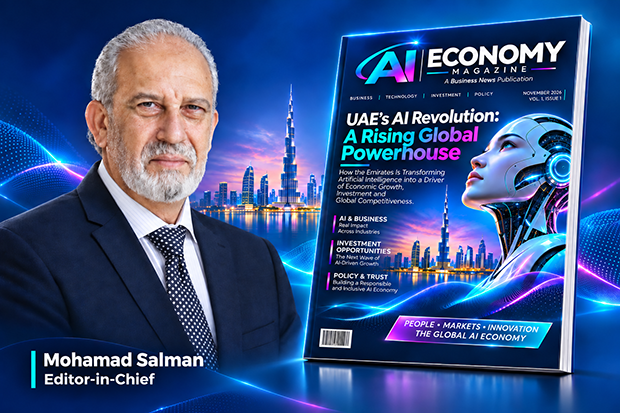
This belief has inspired us at Business News Media Group (BNMG) to launch AI Economy Magazine, a specialised print publication and digital platform dedicated to the rapidly expanding economy of artificial intelligence.
The launch marks an important addition to our media network and reflects our conviction that the economic impact of AI deserves consistent, informed and specialised journalistic coverage.
Our ambition is not simply to create another publication reporting on new applications, product launches or technology announcements.
We want AI Economy Magazine to become a trusted source of insight into the economic forces driving this transformation: where investments are flowing, how businesses are adapting, which industries are changing and who is helping shape the next chapter of the global AI economy.
The magazine will place particular emphasis on the United Arab Emirates and the wider GCC while maintaining an international perspective on developments influencing regional and global markets.
Our editorial coverage will explore AI investment, emerging companies, corporate strategies, technological infrastructure, financial markets and the growing application of artificial intelligence across traditional industries.
We also intend to bring forward the perspectives of those shaping this sector, including business leaders, investors, researchers, entrepreneurs and policymakers.
Through executive interviews, market analysis, industry features and informed commentary, we aim to go beyond daily headlines and give readers a clearer understanding of the opportunities and challenges ahead.
For me, this initiative also reflects the wider responsibility of business journalism.
A specialised publication should do more than repeat corporate announcements or celebrate technological breakthroughs. It should ask the questions that matter.
What real economic value is being created? Which businesses and communities will benefit? How can investment translate into sustainable growth? Are companies prepared for the changes ahead? And how can innovation advance without overlooking its social and ethical implications?
These questions will help shape our editorial direction.
As we introduce AI Economy Magazine, we do so with pride and a clear sense of responsibility. Our goal is to encourage informed discussion between technology and business leaders, support a better understanding of the emerging AI economy and provide balanced coverage of a sector that will increasingly influence our future.
We do not claim to know exactly what the world will look like in the age of artificial intelligence. What we do know is that the foundations of that world are being built today, and understanding this transformation is essential for anyone who wants to be part of its future.
The UAE has chosen to position itself at the heart of this change.
At Business News Media Group, we have chosen to follow this journey, document its progress and help explain the economic transformation taking place before our eyes.
This is where our journey with AI Economy Magazine begins, guided by a simple belief: the future of the economy can no longer be separated from the future of artificial intelligence.