New executive education initiative connects international AI expertise with Dubai’s family business sector, helping business leaders turn emerging technologies into practical tools for growth, productivity and long-term competitiveness.
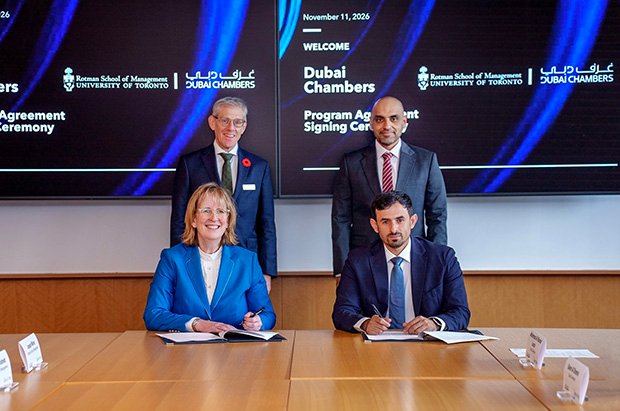
DUBAI, UAE — As artificial intelligence reshapes business operations and management practices worldwide, Dubai Chambers has partnered with the University of Toronto to introduce a specialised executive education programme designed to help family-owned businesses harness the potential of agentic AI.
The initiative represents an important development in Dubai’s efforts to connect international academic expertise with the practical needs of its business community, particularly family enterprises preparing for technological transformation and generational leadership transitions.
Delivered through the University of Toronto’s Rotman School of Management in cooperation with the Dubai Centre for Family Businesses, the programme will equip current and future family business leaders with the knowledge and practical capabilities needed to integrate AI into their organisations.
Connecting Academic Knowledge with Business Applications
Unlike conventional executive education programmes focused primarily on theoretical understanding, the initiative places particular emphasis on translating AI knowledge into real business applications.
Participants will explore how agentic AI, which enables intelligent systems to execute interconnected tasks and support complex workflows, can contribute to operational efficiency, decision-making and business innovation.
The programme will also examine how these technologies can help preserve institutional knowledge, strengthen governance and support continuity between generations.
This focus is particularly relevant for family-owned enterprises, where long-term success often depends on transferring accumulated expertise, business relationships and organisational values from one generation to the next.
H.E. Mohammad Ali Rashed Lootah, President and CEO of Dubai Chambers, emphasised that agentic AI presents a strategic opportunity for family businesses to improve productivity, develop their business models and create new avenues for growth.
He also highlighted the importance of equipping business leaders with the skills needed to translate emerging technologies into applications that deliver tangible commercial value.
A Dubai–Toronto Model for AI Knowledge Exchange
The programme will combine in-person learning in Dubai with three days of company visits and experiential learning in Toronto.
Its five core modules address AI strategy and organisational transformation, the business value of agentic AI, identifying high-impact applications, practical implementation and real-world industry experience.
Throughout the programme, participants will develop AI use cases based on challenges within their own businesses.
These will form the basis of implementation roadmaps covering organisational readiness, governance, strategic priorities and performance measurement.
The Toronto component will provide opportunities to observe how organisations are developing, deploying and governing agentic AI solutions, bringing participants closer to practical examples of technology adoption.
Joseph Milner, Professor and Interim Dean at the Rotman School of Management, welcomed the collaboration as an opportunity to help family business leaders strengthen competitiveness and prepare their enterprises for long-term success.
Strengthening the UAE’s AI Economy
The economic significance of the initiative extends beyond executive training.
Successful AI adoption requires more than access to advanced software. Businesses must also develop leadership capabilities, identify commercially valuable applications, establish governance frameworks and prepare their organisations for technological change.
For family enterprises, these requirements are especially important because technological transformation must be balanced with long-term ownership priorities, data confidentiality and established business values.
By connecting academic research, executive education and practical business challenges, the Dubai Chambers–University of Toronto partnership creates a potential pathway for translating AI innovation into operational improvements.
Its impact will ultimately depend on how successfully participating companies implement the technologies and measure the resulting business benefits.
As Dubai continues strengthening its position within the global digital economy, initiatives of this kind illustrate an essential dimension of AI-driven growth: developing business leaders who can turn artificial intelligence from an emerging technological opportunity into sustainable economic value.
AI ECONOMY MAGAZINE
AI Innovation | Agentic AI | Business Leadership